Things That Go Away

Standard

I moved to Seattle in the fall of 1989, crashing on the couch of the only friend I ever made in college. Months later, we started renting a house with two other guys. All three of them had been part of an improv comedy troupe, but they weren’t happy with the way it was being run, so they quit and formed Jet City Improv in 1992.

I was the only housemate not actively involved in the group but I did a few things to help out, like run the video camera when they needed to record shows. Little stuff. I also spent a lot of time in the audience in the early days when the crowds were thin. It was their thing, not mine, but since I was around them all the time I got caught up in it, too.

Eventually I fell in love and moved out, which meant I wasn’t around Jet City much and was no longer witness to their day to day. I remember the way they moved from venue to venue until they got a dedicated theater of their own up near the University of Washington. It was a great location for them. College students are always looking for something to do and they naturally circulate into and out of the neighborhood. Smart move by the guys, I thought.

When my buddy and I made the (disastrous) decision to make our own cheapie horror film, we were allowed to shoot a scene or two inside the building. A few years later, we took our son to see a holiday special they were putting on, which he liked quite a lot. Not as much as video games, but hey, he’s a 21st century kid.

So I was a little shocked to learn that the theater had been condemned a few years back, and was going to be demolished. Here’s what it looks like on Google Maps as I write this.
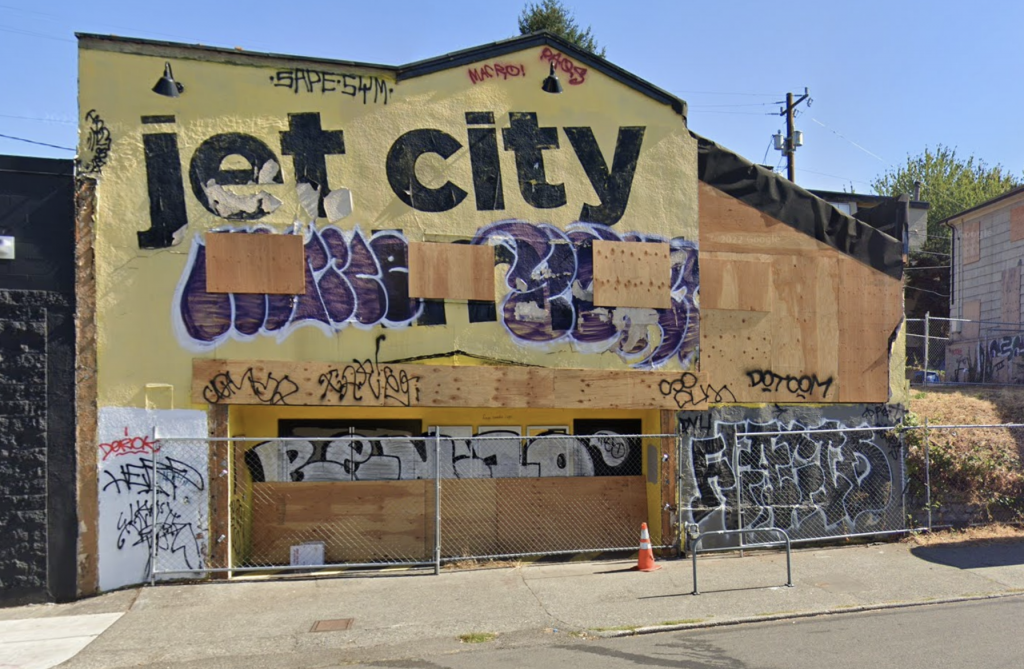
Jet City Improv theater, now condemned and covered with graffiti

Taken from Google Maps, Sept ’22

I remember when they painted the building yellow. For weeks after they moved in, they had friends and acquaintances who wanted to come to the new venue but who couldn’t find it. They’d drive down the street, looking for the theater, and somehow just pass it by. The shadow you see in the lower right is for a bus shelter, but even saying “Next to the bus shelter” didn’t do them any good.

So they bought a few gallons of yellow paint and made the building un-missable.

I remember one of the founders telling me that, as they were slapping on all that bright color, a business owner from across the street yelled at them for making the neighborhood garish or whatever. A week later, that same business owner was telling customers on the phone that they were “across the street from the big yellow theater.”

That’s how I remember the story, anyway.

But nothing last forever. The building sold and was set to be demolished a few years back. It was left to decay, as you can see in the pic above.

And then this happened:
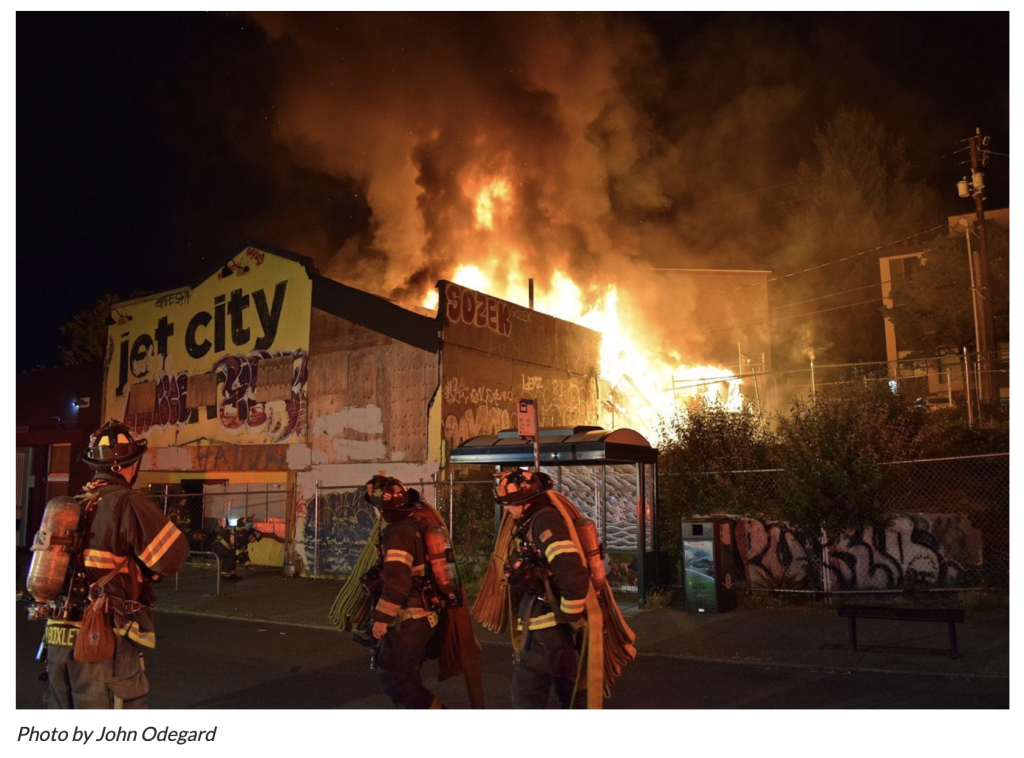
The condemned theater on fire, at night, while firefighters work on it.

This is just a couple of weeks ago.

Here’s a little video:


Supposedly, witnesses heard an explosion when the fire started, and some saw a person on the roof while it–and they–were burning. Firefighters couldn’t recover the body until excavators removed the roof. I can’t find a mention in the media about who this person is, but the SFD has determined that it was intentionally set.

Maybe the body was the arsonist. I certainly hope it wasn’t a squatter.

Seattle has seen a string of arsons at the end of last month. As usual, people are blaming the crimes on whoever they hate most. Some point at addicts living in condemned buildings. Some blame developers who want to get their projects fast-tracked. Personally, I wonder if it could just be a neighbor who hated the way an undemolished ruin makes their neighborhood look. I’ve asked about it but gotten no answer.

And obviously I think it might make an interesting book.

I’m glad Jet City is still active, although it’s sad to think that the building is gone.

There are no permanent things.
Somehow, I’ve Become Scary Again

Standard

For most of my adult life, women crossed the street when they saw me walking toward them.

Not crowded city streets, but in residential areas, where it’s just me heading in one direction reading a library book and them coming in the other direction, often walking a dog, by the time I got within half a block of them, I’d look up and notice that they’d crossed to the other side.

Which is fine. I know there are guys who take this shit personally (I’ve argued with them) but I don’t. People should do what they need to do to make themselves feel safe. What does it matter to me if a neighbor looks me over and thinks “I don’t think so”? It doesn’t. I just wish I didn’t make them feel uncomfortable.

Then, a few years back, I noticed it had stopped happening. I would pass people on the sidewalk–women, men, couples, whatever–and say hello, then move on with our day.

Finally, I thought, I’ve gotten old.

But recently, I’ve made an effort to get out into the neighborhood and walk as much as possible, and it’s happening again. I’m not sure why. I’m fatter than I was during the pandemic. My clothes are a little older. So am I.

So, to the folks in my neighborhood, I’m sorry for making you feel unsafe. I’d stop if I knew what to do. Hopefully, I’ll go back to looking old and harmless and we can go back to saying hello again.

Writing update: I started a new novel that is not 20 Palaces. I told myself that this time I was going to start it off right and write the whole book without ditching the opening chapters and starting over, as I usually do.

I’ve already ditched the opening chapters twice.

Third time’s the charm, right?

What does it look like when someone is drowning? 2023

Standard

Up here in the northern hemisphere, summer is about to start, so it’s time to repost my annual warning:

How to recognize when someone is drowning.

It’s not what you think. Before you take your kids or loved ones into the water, read this article.

Please.

Annual SPFBO Finalist Sale Happening Now

Standard
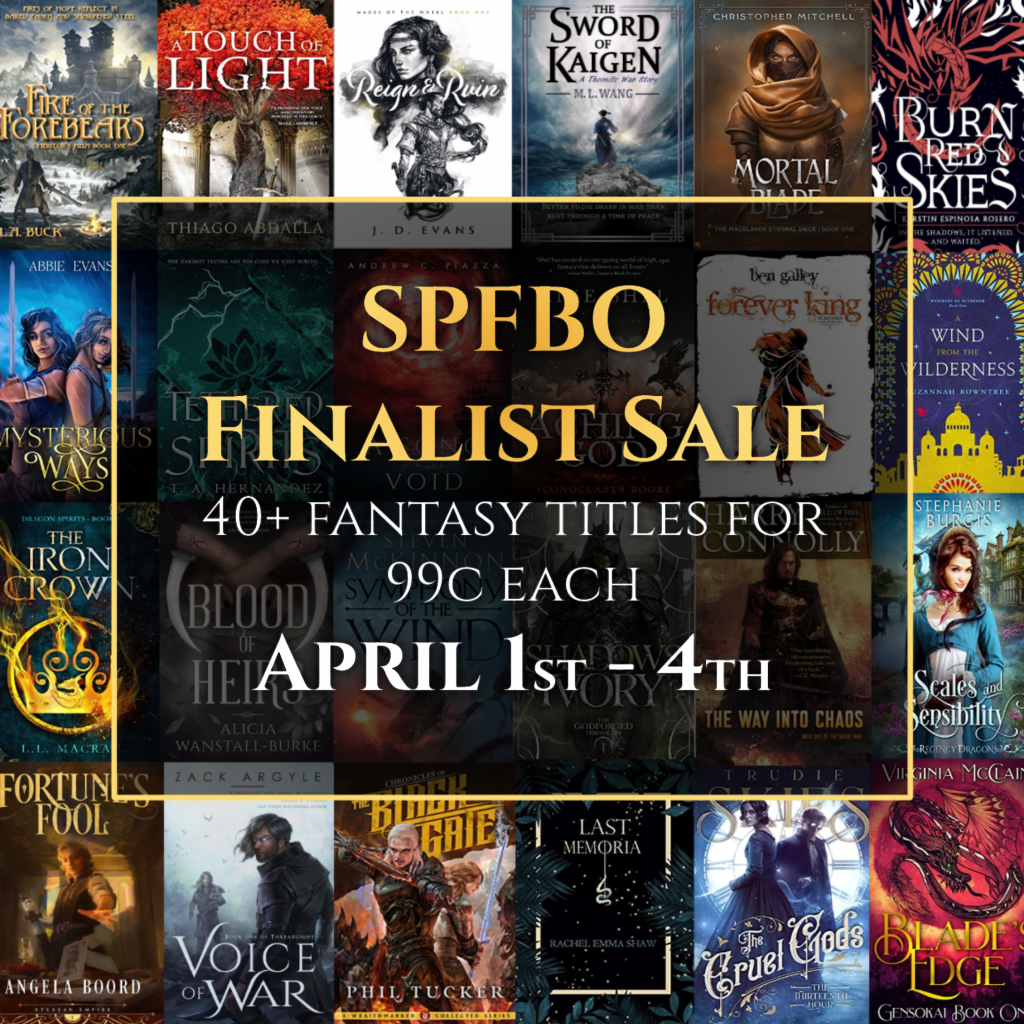
Cover art collage of books in the SPFBO finalist sale

Cover art for *some* of the featured books

Once again, many of the finalists in the SPFBO competition have come together for a group sale.

If you pop over to the sale page for this year, you’ll find a variety of fantasy genres: epic, urban, horror, romantic, grimdark, and so on. If you see something that intrigues, give it a click. Almost all books are priced at $0.99, with only a few at $1.99.

You’ll also find that some authors have added additional books for sale. For example, Twenty Palaces, the first book in that series, is also (still) on sale at 99 cents.

So if you’re looking for new and unusual (or new and traditional) fantasy to binge, check out that page.

Fantasy tropes, character classes, and “The Rules”: Netflix’s Wednesday

Standard

I’ve been meaning to write about the show Wednesday since it aired on Netflix, but it wouldn’t come together. Then I watched this video interview with the showrunners, and heard the interviewer call the show a comedy, and something clicked. 

I like the 1991 film in a middling way. The only parts I really enjoyed were Raul Julia’s face when he gets cut in the duel with Dan Hedaya and the scene where Morticia gives Fester a tour of the family ceremony. “We gladly feast on those who would subdue us.” Excellent. 

But the thing I remember most about that movie was a line from a review (yes, I know that’s weird and I wish I could find it now). In it, the reviewer asks (and I’m paraphrasing from memory) “What are the Addams family? Are they ghouls? Something else?”

And, yeah. I sort of wondered that myself while I was watching, while enjoying the feeling that I didn’t know and would never know. What exactly are the Addams family? Some seem to have weird powers. They welcome torture and death. They’re comical figures, sure, but how are they classified? What neat and tidy category do we put them in? 

Who cares? We might as well ask what the rules are. 

But this is how a great many people experience stories about the strange and unreal. If the story is going to venture beyond the realm of the actual, they need to know how far, and in what direction, and please provide neat boundaries to let us know what we can expect.

Some stories work better this way, sure. Some don’t, and it wasn’t until I heard that woman call Wednesday (the show) a comedy that I realized that I was putting the wrong assumptions onto it. There are many kinds of comedy that have no interest in The Rules.

(Confession time: I sometimes don’t recognize comedies when I’m watching them. See also: A Simple Plan.)

But Wednesday (the show) is also a mystery, and that is a genre that is very much interested in setting up rules. So it made sense that the show is so weirdly rigid where the other Addams family stuff is very much not.

Personally, I’m not a huge fan of Charles Addams original cartoons. They were fine. I didn’t love them. I didn’t connect with them. His famous “Downhill Skier” cartoon is unforgettable, and perfectly exemplifies the point I was making above about comedy and “the rules” but I knew his most popular creation from the black and white sitcom, and as a kid my favorite character was Cousin Itt, who was created especially for the show and not by Addams himself.

So I’m not what you’d call a purist. 

But as much as I enjoyed Netflix’s Wednesday, I couldn’t help but feel annoyed that the show took this weird family of suis generis characters and carefully nestled them into a setting full of stock tropes and character types that are as rigid as a cheap role-playing game. 

At Wednesday’s new school, there are four houses just like at Hogwarts, although they make much less of a fuss about them. The other students are (mostly) grouped by types—werewolf, vampire, siren, gorgon—along with a few psychics bearing traditional psychic powers.

Even the family themselves have been sorted. Now there are outcasts and normies. The normies are… muggles, I guess, who are fully aware that non-muggles exist? The outcasts are everything that’s not a normie, which reframes that weirdly affecting cemetery scene in a way that bothers me. It’s no longer the Addams family itself that must resist oppression by outsiders. It’s their entire group, their whole category, which is apparently defined by the fact that they’re ostracized.

Is it weird to complain this way about a show that I enjoyed, even though it felt at times—especially the climax—that they were filling out a checklist? I would probably have written this post months ago if the show had been a failure, but it’s been wildly successful.

And why not? The young actors are terrific. The jokes mostly land. The story races along. The whole thing looks great. Plus, the rules are clear. And maybe that’s why I enjoyed it but didn’t love it. 

Copenhagen Cowboy: A TV Series Created by a Pantser

Standard

Back in 2001, when the deeply boring movie Lara Croft: Tomb Raider was released, part of the story around it (as I remember it now, 20+ years later) was that director Simon West threw out the scripts he was given (apparently the producers had more than one writer working separately and simultaneously) and, with a pair of co-writers, wrote a new one in a week or two. Apparently, he said it was not that hard.

A review I read at the time (which I can’t find at the moment) seized on this quote, because of course writing is easy if you don’t care how (or whether) the sequences fit together, or even if they belong together at all.

I was thinking about this quote as I watched Nicolas Winding Refn’s Copenhagen Cowboy.

On one level, CC is a story about a woman with supernatural powers who is forced to survive in a world of ruthless mobsters. She is considered to be a “lucky coin,” someone who brings good luck/grants wishes, but no one trusts her and she gives every impression of being passive and helpless until suddenly she isn’t.

On another level, CC is an art film with long lingering shots in which nothing happens, slow circular pans in rooms where more time is spent on the wallpaper than the characters, shots full of color, and beautifully composed images.

Me, I like both of these things, and so Copenhagen Cowboy ought to have been my absolute jam. Instead, I admired it more than I liked it. I indulged it by giving it my time instead of feeling moved.

Most of the time, anyway. I certainly loved sections of it, but overall?

Nah.

There are many art films that don’t want the audience to engage with them on a literal plot and subplot level—movies where you just sit back and experience it. They don’t offer the easy engagement of narrative, because the audience response comes from something else.

Copenhagen Cowboy wants both elements, but doesn’t know how to combine them. It’s a chaotic jumble of pretty shots, images of women being degraded, rotating camera POVs, gross/grotesque imagery, and supernatural nonsense. It’s an interesting failure and little more.

Then I found this interview with him on Vulture. In it, he says that the title of the show has no relation to the show itself. He just thought it sounded cool.

Also, that he shot the series in chronological order so he could change things on the fly “based on how [he feels] in the morning”. For example, there was a scene where the protagonist talks about being abducted as a child, and he changed it at the last moment to being abducted by aliens. Why? Because he’s “always been interested in science fiction”.

In the third episode, he suddenly decided that the main character knows kung fu, so they brought in a trainer and choreographed a big fight scene.

When I read this part of the interview, it occurred to me that my experience of watching all this Dumb Pretty Art TV must have been similar to the experience of the cast and crew as they made it. What? I’m part of an intergalactic race now? Oh, we’re going to resolve this confrontation with a martial arts battle? Okay then. Let’s, um, make that happen.

And this moves the show out of the “interesting failure” category into something much dumber. I’m usually in favor of characters going all karate on each other, but it’s so commonplace that it needs a commonplace structure around it. It can’t be thrown in as a last minute change because you have no idea what should happen next.

That’s the kind of easy writing that doesn’t care how the scenes and sequences relate to each other.

But NWR can (sort of) get way with this in a way that Simon West can’t. Lara Croft: Tomb Raider has a lot of beautiful people, locations, and shots, but they aren’t beautiful in an art-house style. LC:TR is beautiful in the background while other, much-plottier stuff is going on.

With Copenhagen Cowboy, the story stops for beauty. The extended rotating pans around a 360 degree set are an intentional (and condescending) choice by the director to deny the audience the kind of editing that grabs your attention. The grotesquery is designed to unsettle. The ambiguity is meant to intrigue.

And I’m pretty sure the scenes of beautiful women in degraded circumstances are supposed to titillate.

None of this is as successful as the director’s fans hope it will be. Personally, I wanted to be one of those fans, but it’s not going to happen on the strength of this show. Not when it feels so careless.

Random comments: NWR talks about this season as the start of his hero’s journey, with a second season ready to go. However, I was sure that the sequence of images at the end of the season showed the main character dying. Ambiguity, people. It’s how you recognize Real Art.

Finally, that Vulture interview I linked above is kinda hilarious. NWR is so fully committed to his Euro Art Nerd persona that he talks about his audience as though he’s “educating children.” He also says he wept with pride often when his daughter, hired to play a critical part that was added at the last minute, refused to take his direction. Amazing.

Annual Repost: The Most Beautiful and Frightening Version of A Christmas Carol

Standard

Link, in case you can’t see the embed.

Remember, the True Meaning of Christmas is paying your employees a decent wage.

I Don’t Have A Venmo Account

Standard

In case anyone out there needs to hear this: I don’t have a Venmo account. Please don’t send money to me through that service. That’s not me.

I got an email on Saturday congratulating me on opening an account, and I assumed it was phishing and sent it to Spam. Then the emails kept coming, and a quick check showed they were from the actual company.

Fun fact! In their original email, Venmo included a “Not you? Click here” -style link that would remove my email address from whatever account had been created with it.

Another fun fact! That link didn’t work.

So it’s been the usual back and forth with the help people, who per standard practice skim over my initial message and offer advice that doesn’t work for me. At this point, it seems we’ve reached the stage where they have blocked that email address, but I keep asking if it has been used to trick people into sending money and somehow the support staff keep missing that message.

God, the future is stupid.

Anyway, I don’t have a Venmo account. If someone impersonated me in that service and asked you for money, please report that.

And The Killer Is… You Decide! ttrpgs, genre simulations, and game systems

Standard

For years, I’ve been picking up the odd indie game here and there, trying to find (among other things) one that seems like it could be a great mystery game. I haven’t really found a promising option.

Generally, they fall into two categories. The first is exemplified by a teen detective game called Bubblegumshoe, by Emily Care Boss (among others) and published by Evil Hat Games. Bubblegumshoe uses the GUMSHOE game system which, despite the name, I’ve usually seen in horror games. GUMSHOE separates “abilities” into two categories. First are General Abilities, which let you roll against them and you succeed or fail in the ordinary way. 

Second are Investigative Abilities. If there’s a core clue that you need to solve the mystery, and a PC is on hand with the Investigative Ability that would acquire the clue, it’s acquired automatically. GUMSHOE doesn’t let a game stall or derail because a bad die roll, or a series of them, prevents the characters from snapping up a necessary clue. That’s an essential mechanic for horror games, because the antagonists are supposed to be overwhelmingly powerful compared to the PCs. That’s part of what makes it horror. There’s usually a very narrow path to victory for the players, and if they’re denied the information they need to find that path, the game is an automatic failure and not much fun. 

Like I said, it’s a clever mechanic. But to use it in a mystery story, you also need a GM who is capable of setting up a mystery plot, full of red herrings, fake but seemingly unbreakable alibis, and all the other tropes of the genre. And take it from me, a guy that’s tried his hand at mystery more than once, that’s a challenging skill set to acquire.

Alternately, we have the cozy mystery/cosmic horror game Brindlewood Bay, a Powered by the Apocalypse system by Jason Cordova and published by The Gauntlet. In this game, the PCs are elderly members of a local mystery book club in a small, coastal New England town. Individual adventures are cases, like an episode of Murder, She Wrote in which mystery readers nose around crime scenes, solving murders.

Except PbtA is a “Play to find out” system. The GM doesn’t create a clue trail. That’s actively discouraged. Instead, they create a story prompt and a list of generic clues like “an unsigned will” or “a photograph of the victim”. During play, the players themselves add the necessary details that will separate the clue trail from the red herrings, then roll dice to see if this is the solution.

Which is fine, but it doesn’t give the player the experience of solving a mystery. It puts them into the role of creating the mystery.

I had a similar issue with a Forged in the Dark game I actually got to play some time ago. The game was called Hack the Planet (written by Fraser Simons and published by Samjoko Publishing). It was cli-fi mixed with cyberpunk, and while I can be lukewarm on cyberpunk in general, this was a cool setting. Maybe the most interesting expression of cyberpunk I’ve ever come across. 

But I was very interested in trying out the system. FitD games were the new hotness at the time (and maybe they’re still the current hotness, I wouldn’t know) because they let people role play heist plots.

Personally, I love a good heist film. And when someone creates a heist-oriented fantasy game that not only wins awards and gets raves all over the internet, it spawns a number of clones in other genres, well, I’m interested. I really wanted to try that.

Except once we started playing the game, it turned out that the thing that makes heist plots most appealing to me—that unexpected twist where the moment everything is going wrong turns out to be part of the plan all along, and how did I miss the scattered clues that would have prepared me for that twist—is utterly neutered. The surprise of that moment is replaced by a player saying “I spend two stress.” No surprise. No thrill. 

And it sort of has to be. How else can you play out this sort of story in this medium? And the fact that I stupidly held out hope that the game could replicate the feeling of the movie has to be yet another triumph of hope over experience. I should have kept my expectations low. 

For me, without that surprise, the game was all tension and no thrill. 

I can see why people like that system. Not only does it have some cool ideas, it’s very fussy and is full of little boxes to check. It’s a game for the bullet journal/to-do list crowd. To me, it seemed underpowered and all that fussiness made it feel like a resource management game, which I hate. Cool setting, but that ruleset was actively unpleasant on several axes.

Which is a shame. I like heists, almost as much as I like mysteries. If I could figure out a way to capture the essential parts of them in a way that felt manageable in a game, I’d be pretty happy about that game. 

But I’m not holding my breath. Not every genre works in every medium. 

By the way, I have two new Twenty Palaces novels out:

The Iron Gate

The Flood Circle

Who Cares about Barb Holland: Nothing Characters and Fictional Death

Standard

In my previous post, I said I was going to start trying to write shorter blog posts, which I would be able to finish in a reasonable length of time and which would then, with luck, actually be posted. That’s preferable to writing long, complex posts about six related topics that need to be reorganized four or five times and therefore never actually get finished.

Also in that previous post, I pointed out some errors in a particular review of Stranger Things 4, arguing (once again) that disinterest makes reviewers inattentive. But there was a section of the review that was wrong for a different reason, and I would rather talk about the issue separate from the review itself, because I’ve seen it echoed elsewhere more than once.

It’s the idea that Barb Holland is a “nothing character” and her death shouldn’t be such a big deal. 

I’m not surprised that people make this mistake. It’s commonplace for horror or thriller shows to introduce a character solely for the purpose of killing them off. It’s a clear and easy way to establish the threat the villains/monsters/whatever present. And Barb is that character. She’s dead by the first few minutes of episode three and up to that point she’d had maybe 30-some lines of dialog. 

So, a throwaway, right? Motivation for the plot, an excuse to show two frames of the monster’s face and another mysterious disappearance for everyone to scratch their heads over.

And maybe she would have been, if this show had been on the CW or something. The CW would have cast a thin, pretty underwear model, hung some nerdy/preppy accessories on her, and when she died she would have been completely forgettable. 

The Duffer Brothers went another way. They cast Shannon Purser, an attractive but overweight actor, then dressed her all the way down in the uncoolest clothes, glasses, and hairstyle they could manage. She defined Barb with in her big jeans and high frilly collar and giant glasses, clutching her schoolbooks to her chest and calling Nancy on her bullshit.

She was different. Vulnerable. Smart. Excluded. Specific. And a big segment of the viewers saw themselves in her. Barb was created to elicit sympathy in a way that the Lab Coat Guy, who appeared in the very first scene in the series, could not. Also, as Nancy’s best friend, as I’ve talked about, Nancy’s concern for her completely upends the teenage romantic plot that the show was building from the first two episodes.

Barb mattered to the characters onscreen and to the audience offscreen.

It’s not like Stranger Things doesn’t have nothing characters. Lab Coat Guy was one. The broken bodies strewn around Hawkins Lab in season two or the hospital in season three were not personalized, for the most part. They were extras dressed in blood spatters. But they didn’t have personality or specificity.

When I was writing Child of Fire, I wanted that first “death” by the side of the road to be memorable. And, judging by people’s reactions, it was.

But as much as I tried to turn it into someone no one had ever seen before–to the point where the kid doesn’t even really die–I didn’t take the time for him as a character. The circumstances of his death are memorable (as are the circumstances of Barb’s death, since it’s the first scene set in the Upside Down) but not him. I sort of wish I’d done what the show did, and gone for both.

The conversation reminded me of a comic book, number 12 in the run of Grant Morrison’s “The Invisibles” which some people have called the greatest single issue of a comic book ever. In the first issue of this run, the villain/anti-hero King Mob shoots a guard while he’s invading some facility or other. It’s a single panel (maybe two, I haven’t seen it lately), and he doesn’t even pause in his dialog. It’s a moment designed to show King Mob’s ruthlessness as he guns down a nothing character. 

The story continues until issue 12, when it stops and returns to this nothing character. It portrays his life, all jumbled up, showing the abuse he suffered as a child, the abuse he perpetrated as he grew up, the people he cared about, how he hurt those people, and how he died. At which point, he wasn’t a nothing character any more. 

And really, none of them are, but depending on the genre, the story has to treat them like set dressing sometimes, because there have been so many and we can’t delve into the backstory for all of them. 

That was the case for the kid in my book. After he’s gone, Ray and Annalise dig through his home, looking for clues about who he (and his family) were and what happened to them. After that, he faded away. He wasn’t nothing, even after the story was done with him. 

The same is true for Barb, although judging by season four, the show is not done with her yet.

In personal news, I’m working through the notes I received for The Flood Circle, making sure all the story beats are clear and every important moment has the emphasis it needs. I’m also fussing with the text.

If you’re a Kickstarter backer for these books, expect a somewhat more detailed update around the start of August.

I’m also trying to work out what project I’ll tackle next. There’s an idea that’s really nagging at me but I don’t think I’m the one to write it. Also, it turns out that my son is already tackling a very similar project, and under no circumstances should his dad bigfoot his latest thing.